Why Taking More Pole Classes Isn't Always the Same as Training Better
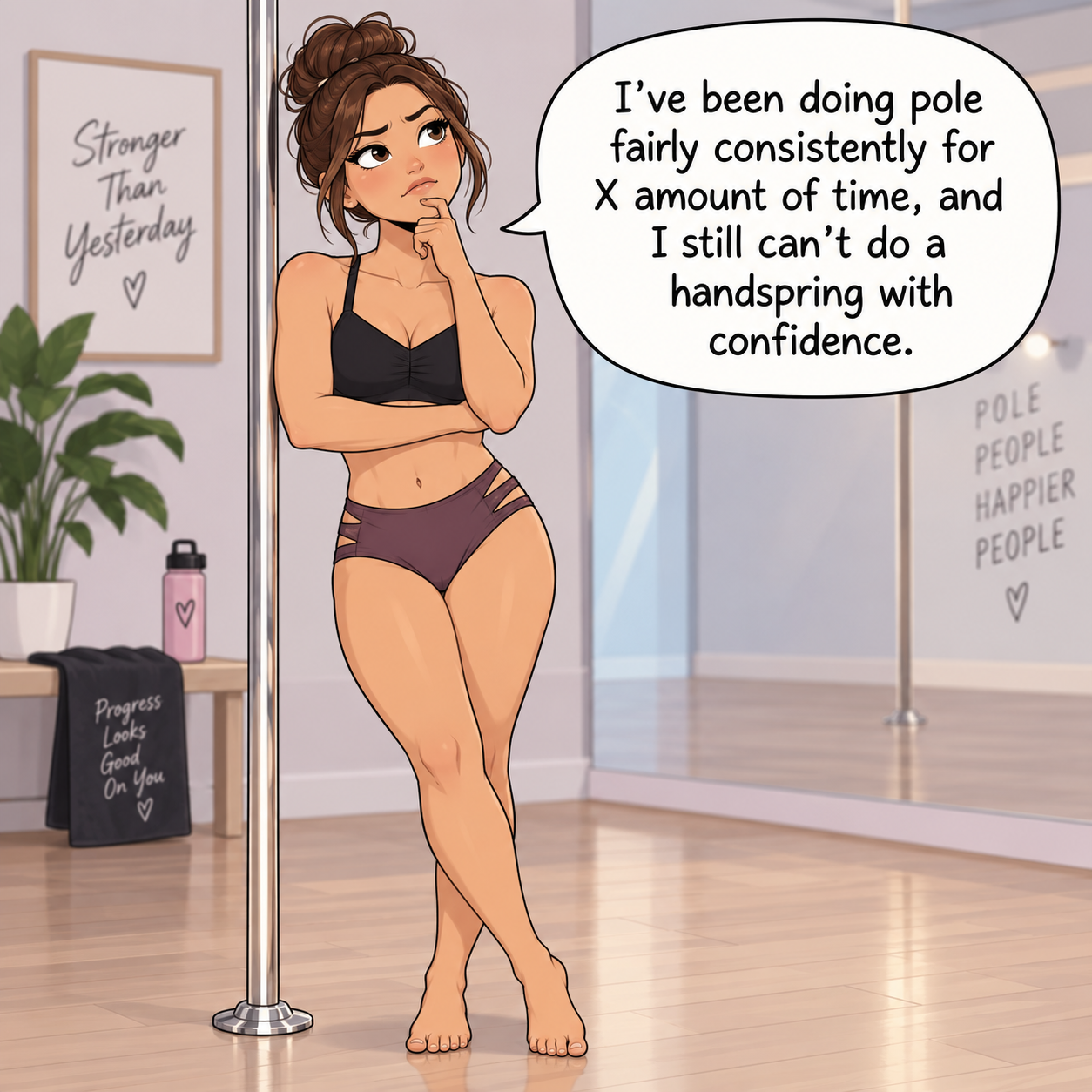
I have heard pole dancers say this before:
“I’ve been doing pole fairly consistently for X amount of time, and I still can’t do a handspring with confidence.”
But their weekly classes might look like this:
Tuesday: choreography
Thursday: spin pole flow
Saturday: tricks class
They are training consistently, but very little of that training time is actually directed toward the strength, technique and prerequisites needed for a handspring.
You may have heard the phrase “random training creates random results.” Taking different classes is NOT a bad thing—variety can help you become a more well-rounded pole dancer. But if you have a specific goal to achieve, you usually need some specificity in your training.
That means repeatedly dedicating part of your training time to the same goal for a block of roughly 4–8 weeks, and sometimes longer depending on the skill and what is limiting you.
Let’s use Ayesha as an example
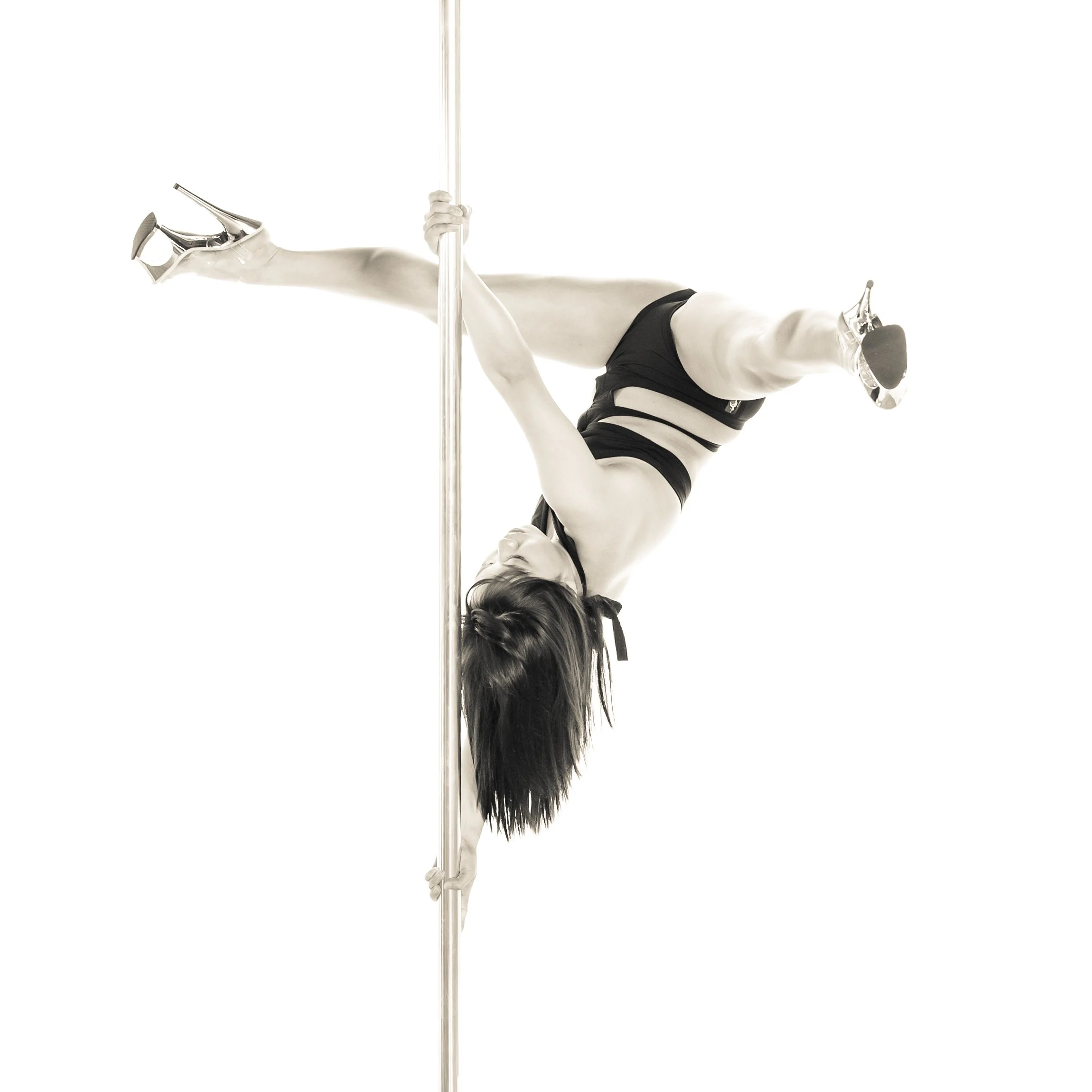
Let’s say you are an intermediate pole dancer who can already:
aerial invert with relatively straight legs
hold a solid butterfly
maintain a strong split grip from the ground
Let’s also assume you do not have an active injury and that strength and familiarity with the movement are your main limitations.
For ayesha, we need a strong pulling top arm that requires your lats, biceps, and traps strength, and the bottom arm needs strong overhead pushing strength that requires your triceps, pecs, and serratus anterior strength.
If Ayesha is your goal, I would suggest some form of relevant shoulder and arm conditioning every time you have access to the pole—ideally around 2–3 times per week.
For example,
Your conditioning to bridge your stregnth gap could be:
Pole lat pull down: 1–2 sets of 8–10 reps
Sit climbs: climb the pole 1–2 times using mainly only your arms
Split-grip holds: up to 5 holds per side
Scapular push-ups o the ground: 1–2 sets of 5–10 reps
Single-arm triceps extension on the pole: 5–10 reps facing the pole and 5–10 reps with the body turned sideways
The exact volume will depend on your level, fatigue and what else you are doing in class.
Instead of trying Ayesha over and over again, you can gradually load the shoulders in the same position progressively.
For example, your progression for skill acquisition might include:
Butterfly
Extended butterfly
Inverted D
Pressing from an upright thigh hold straddle to butterfly
Opening one leg from an inverted D
Gradually opening both legs toward Ayesha
You may spend several weeks working on one stage before moving forward, while another stage may come very quickly. The important part is that your training continues to move toward the same overall goal.
“What if I don’t have a pole at home?”
You can still make progress.
If you only have access to a pole during class, use the time you do have intentionally.
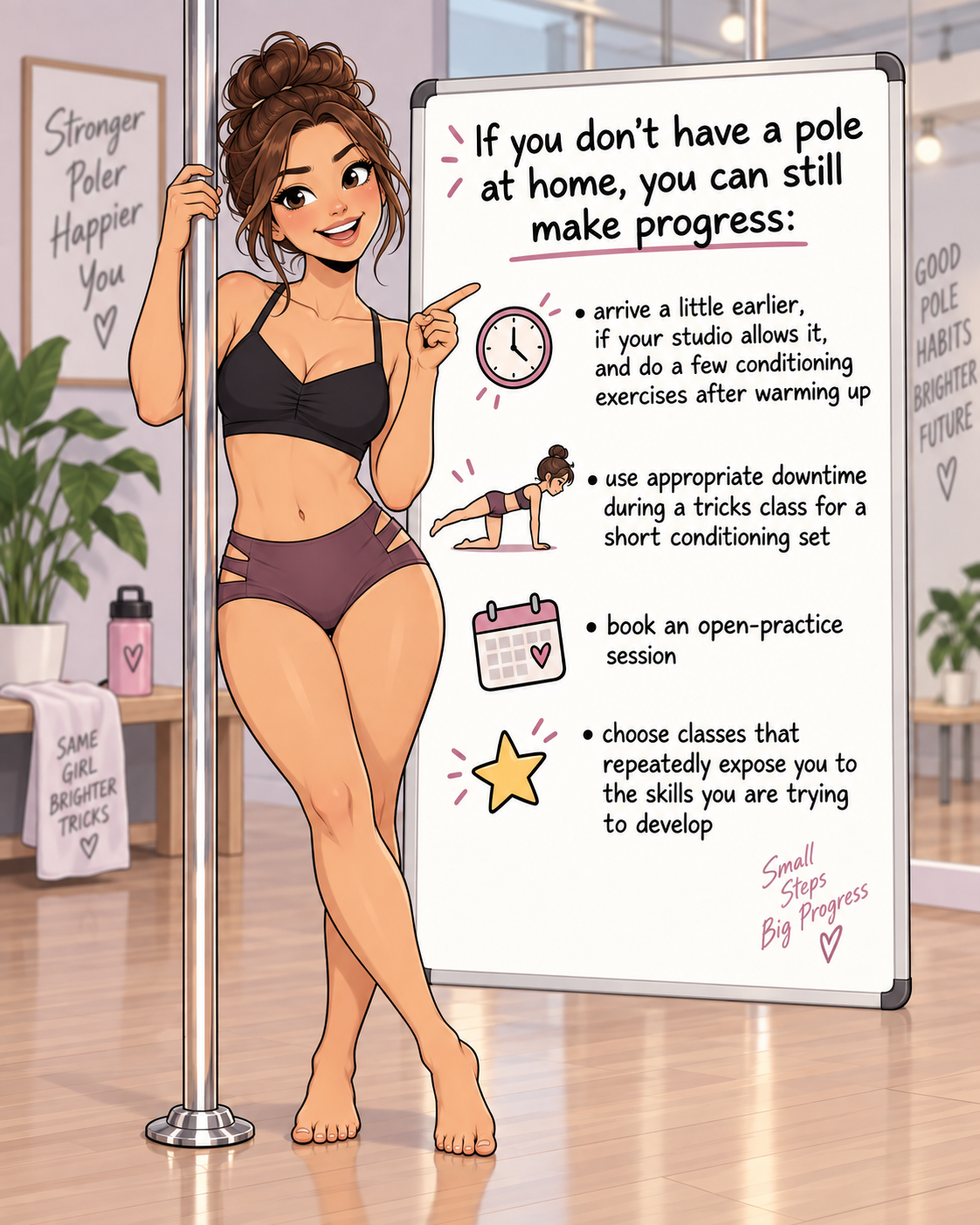
Tips for fitting conditioning in your life
You might:
arrive a little earlier, if your studio allows it, and do a few conditioning exercises after warming up
use appropriate downtime during a tricks class for a short conditioning set
book an open-practice session
choose classes that repeatedly expose you to the skills you are trying to develop
You can also tell your instructor what you are working toward. They may be able to suggest appropriate progressions or help you use your class time more effectively.
The goal is not to turn every pole class into a full-on training session. You just need to keep giving the relevant muscles and movement patterns a consistent stimulus.
If you love taking choreography, spin pole, heels and random tricks classes, keep doing them.
But if there is one skill you really want to achieve, make sure some of your weekly training is consistently directed toward it.
What if you have multiple goals at the same time?
If you have a 9–5 job, your free time for training is limited. You probably cannot give every goal the same amount of attention at the same time.
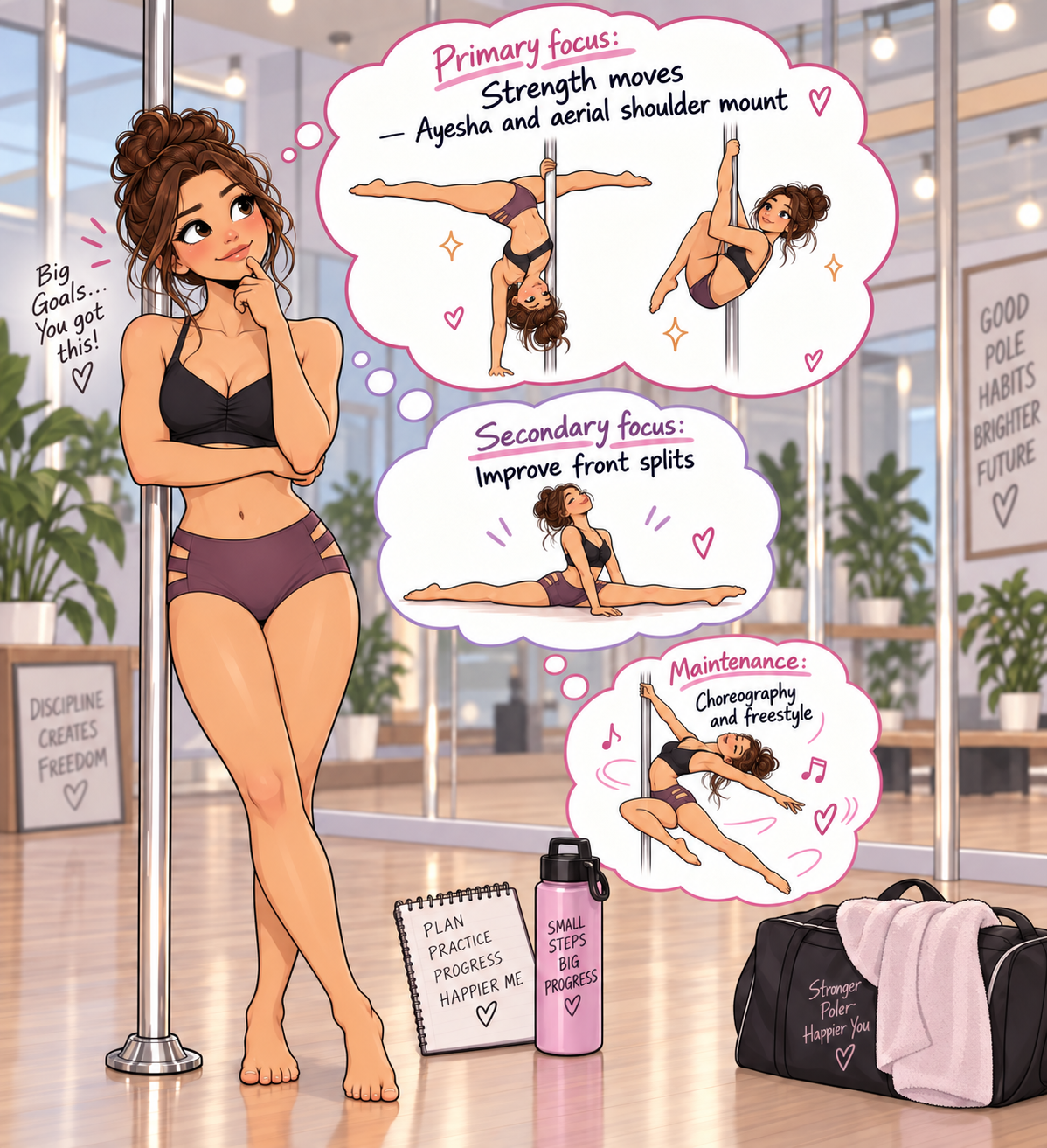
Instead, think about what you most want to improve during your next training block and organize your training around a primary focus, secondary focus and maintenance goals.
For example:
Primary focus: Strength moves — Ayesha and aerial shoulder mount
Secondary focus: Improve front splits
Maintenance: Choreography and freestyle
Then, in your next training block, you might rotate your priorities:
Primary focus: Choreography and freestyle
Secondary focus: Improve front splits
Maintenance: Strength moves — Ayesha and aerial shoulder mount
Maintenance does not mean you stop training something completely. You simply give it enough attention to maintain what you have while putting more of your time and energy toward another goal.
And it is okay if a skill takes longer to develop.
You do not have to achieve everything within one training block. Some goals may take several blocks, especially when they require significant upgrades compared to your current strength and flexibility levels.
Rotating your priorities can make your training more manageable and allows you to continue working toward several goals without overwhelming your training and potentially leading to injuries if you do too much at once.
And if your goal is simply to have fun, explore pole and try different things, then random drop-in classes are completely fine.
In that case, variety is actually aligned with your goal.
There is nothing wrong with training that way. The important thing is that your training matches what you want to get out of it.
My own experience with this
I am writing this as someone who was that girl in my late 20s who just went to random pole classes 3–5x/week, sometimes taking more than one class a day with my monthly unlimited pass.
I did achieve most of what I wanted at the time, but eventually I had no idea how to keep progressing from there.
I stopped pole for a good three years after COVID, and when I came back, I had to rebuild my pole strength from invert onwards. Except this time, the process was much faster because I had a plan, along with the muscle memory from the past.
I also achieved moves I was not able to do pre-COVID, such as Iron X on my bad side and a deadlift Ayesha, despite the fact that I was actually pole training much less—around 2x/week.
The difference was that I was much more specific with my goals, and I also learned better technique through my pole privates with Emily at Aerial fifty two in Mississauga, which helped me get there.
I hope this is helpful and gives you some guidance on how to structure your own training. Happy poling!
