What Happens When You Have Tendinopathy?
So, the doctor or your imaging showed that you have tendinopathy, and you start to wonder: How did I get here?
It could be golfer’s elbow, tennis elbow, rotator cuff tendinopathy, Achilles tendinopathy… etc.
A tendon is the part that connects muscle to bone. Since you are attaching something that moves—the muscle—to something relatively rigid—the bone—the tissue needs to be able to tolerate and transmit a lot of force.
I like to think about a tendon like a spring. It is an interface that can absorb load and transmit forces from the muscles to the bones.
Why Did My Tendon Start Hurting?
Often, there has been a mismatch between what the tendon can currently tolerate and what you are asking it to do.
Maybe you suddenly picked up a new hobby, started taking more workout or pole classes because you got an unlimited membership, trained the same high-load movement too many days in a row, or attempted the same trick too many times in one session trying to get it for the 'gram.
In all of these situations, the amount of load increased faster than the tendon had time to adapt to it. Over time, this can lead to pain and a reduced ability to tolerate the same activity.
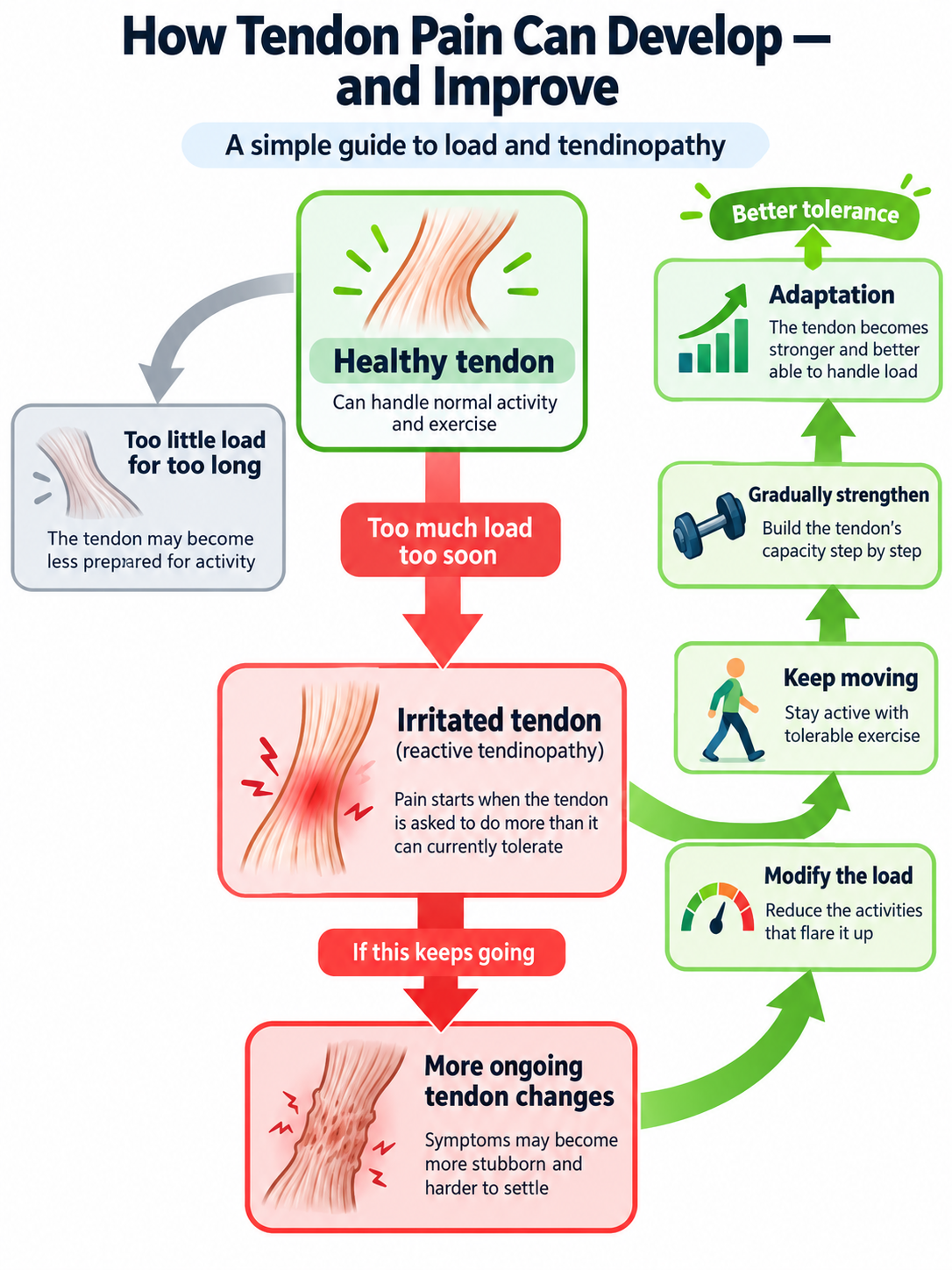
Tendinopathy Load Management and Progressive Loading
Tendon rehabilitation is about finding the right amount of load—reducing activities that flare symptoms while gradually building strength and capacity.
Why Complete Rest Usually Isn’t the Answer
Things I commonly hear are:
“I rested it, but every time I go back to the movement or activity, it still hurts.”
I often explain tendon health a little bit like osteoporosis: your body responds to the demands you put on it.
If your body hasn’t been doing a specific sport or activity for a while, there is less reason for it to maintain the same capacity to tolerate that activity. When you stop loading a tendon, its ability to tolerate load can decrease.
Then, the next time you go back to the sport, the tendon may still not have enough capacity to tolerate what you are asking it to do, and pain can return.
I once heard someone use this analogy, and it makes perfect sense to me:
If you have a broken car, would you put it in the garage and hope that in three months the car will fix itself?
It is similar with tendon rehab. If you do nothing except rest, the symptoms might settle down, but you haven’t necessarily built the tendon back up for the activity you want to return to.
For something like a small cut, resting and waiting may be enough. Tendons are different because eventually they need to tolerate load again.
Researchers in tendinopathy, including Karin Silbernagel and Jill Cook, have repeatedly emphasized the importance of load management and progressive loading. This is also supported by larger reviews showing that resistance exercise is an important part of tendinopathy rehabilitation and that gradually increasing load can help improve pain and function.
Complete rest can reduce a tendon’s ability to tolerate load, while appropriate loading is an important part of rehabilitation.
But Why Can’t I Just Keep Training Normally?
You got to where you are partly because your body cannot currently handle the amount or type of load you are feeding it.
If you keep doing exactly the same thing, you may keep getting the same result.
Essentially, if the amount or intensity of your activities continues to exceed what the tendon can tolerate, symptoms may keep flaring up.
In the early stages, reducing the amount, frequency, intensity, or type of activity that aggravates the tendon can help settle symptoms while you build up the tendon’s capacity with rehabilitation exercises.
Activity Modification ≠ Stopping Everything
But how do you know if you are doing too much or too little?
This is the tricky part.
A lot of people may not realize which activities in their daily life or training are contributing to their symptoms.
One way we can monitor this is by looking at how much pain you have during the activity, afterward, and the next morning.
Using a 0–10 pain scale, where 0 is no pain and 10 is the worst pain imaginable:
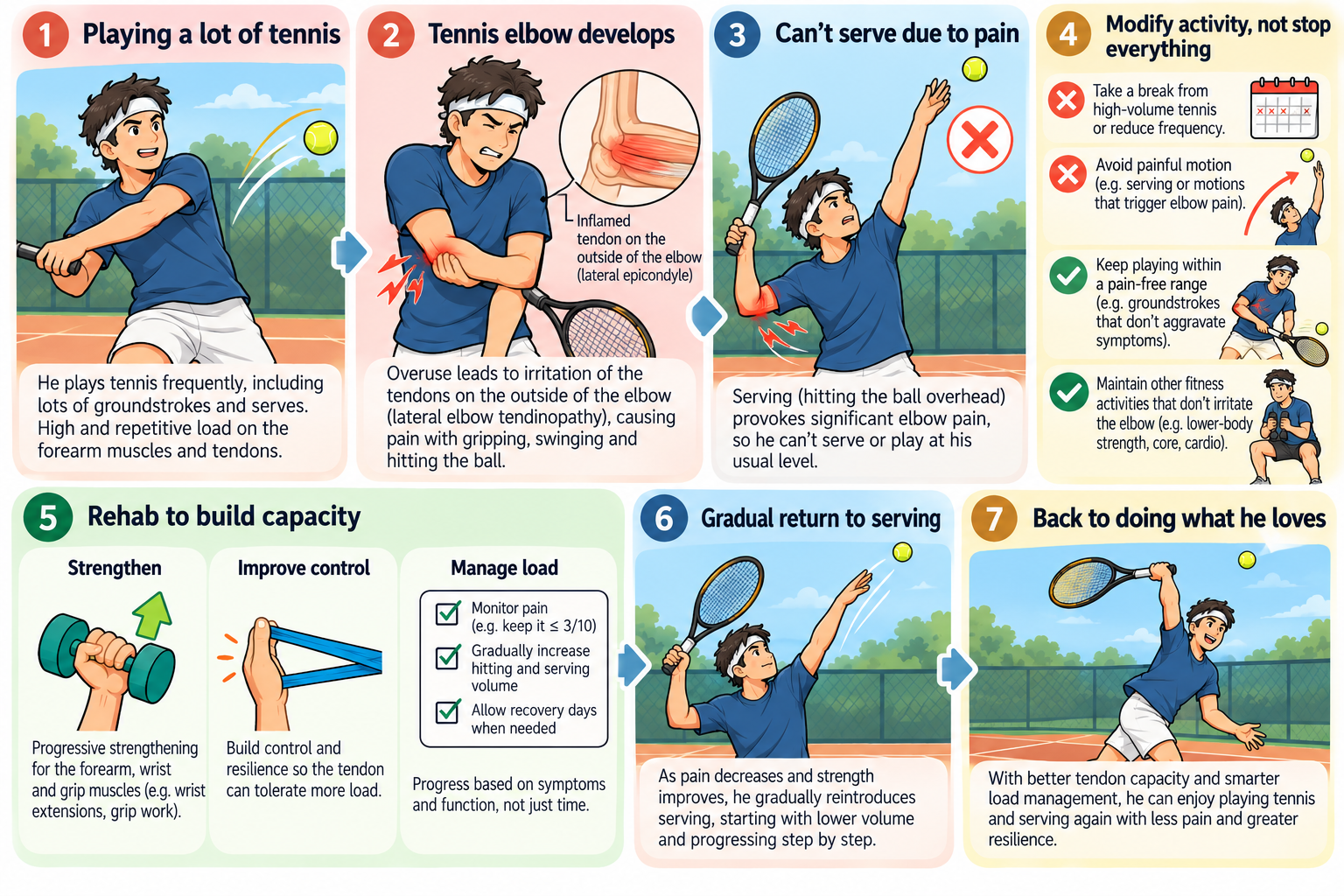
Pain may be allowed to reach up to 4-5/10 during the activity.
Pain after completing the activity should remain within an acceptable level.
Pain the morning after the activity should not be significantly worse.
Pain and stiffness should not continue increasing from week to week.
This type of pain-monitoring approach has been studied in people with Achilles tendinopathy. It can be a useful guide, but the exact amount of acceptable pain should still be individualized depending on the person and the tendon involved.
For example, a pole dancer with golfer’s elbow might temporarily have to switch from a tricks class to floorwork or ground acrobatics, or limit the amount of time spent working on Butterfly/Ayesha-type movements until the tendon builds up more capacity.
Sometimes, for milder cases, education and modifying the aggravating activities can be enough.
Other times, you may need to spend a few weeks to a few months building up the tendon’s capacity with exercises.
What Does Tendon Rehab Look Like?
We might start with:
light-weight or resistance-band strengthening exercises
increasing sets and repetitions
increasing resistance or weight
increasing range of motion
increasing speed
adding faster, spring-like movements such as hopping, jumping, or running for lower-body tendons
progressing toward sport-specific loading
returning to sport
Eventually, the rehab has to resemble what the person actually wants to do.
A CrossFitter needs to be able to do box jumps and run.
A pole dancer needs to be able to pull, push, grip, and perform dynamics release.
A tennis player needs to be able to do overhead serve, run, and lunge with speed.
The goal is not just to make the tendon feel better.
The goal is to build enough capacity that the tendon can tolerate the activities you actually want to return to.
References
Cook JL, Purdam CR. Is tendon pathology a continuum? A pathology model to explain the clinical presentation of load-induced tendinopathy. British Journal of Sports Medicine. 2009;43(6):409–416.
Pavlova AV, Shim JSC, Moss R, et al. Effect of resistance exercise dose components for tendinopathy management: a systematic review with meta-analysis. British Journal of Sports Medicine. 2023;57:1327–1334.
Breda SJ, Oei EHG, Zwerver J, et al. Effectiveness of progressive tendon-loading exercise therapy in patients with patellar tendinopathy: a randomised clinical trial. British Journal of Sports Medicine. 2021;55:501–509.
Silbernagel KG, Thomeé R, Eriksson BI, Karlsson J. Continued sports activity, using a pain-monitoring model, during rehabilitation in patients with Achilles tendinopathy. American Journal of Sports Medicine. 2007;35(6):897–906.
Desmeules F, Roy JS, Lafrance S, et al. Rotator Cuff Tendinopathy Diagnosis, Nonsurgical Medical Care, and Rehabilitation: A Clinical Practice Guideline. Journal of Orthopaedic & Sports Physical Therapy. 2025;55(4):235–274.
