Remember how sore you were after your first gym session, pole class, or trying a new sport? Sometimes even walking down the stairs or sitting on the toilet feels like a challenge the next day!
This is called delayed onset muscle soreness (DOMS). It typically develops after unfamiliar or particularly demanding exercise, peaks around 24–72 hours afterward, and gradually resolves over the next few days.
But here's the interesting thing: after doing the same exercises consistently for a few weeks, you probably don't feel nearly as sore anymore.
That's because your muscles are adapting to the exercise.
But what if you've been doing the same workouts at a similar intensity for 3 months, and you're STILL getting really sore after every session? Or you feel like your body is taking forever to recover?
Shouldn't your body have adapted by now?
While there are several reasons why you might experience persistent muscle soreness, including changes in training volume or intensity, it's worth looking beyond your workouts.
Are you actually giving your body enough time and resources to recover?
The Recovery Pyramid: Are You Taking Care of the Basics?
When people think about muscle recovery, they often think about stretching, foam rolling, massage guns, or getting a sports massage after a hard workout.
And while these strategies may help you feel better, they're not necessarily where your recovery efforts should start.
I like using the concept of a Recovery Pyramid to explain what we should prioritize.
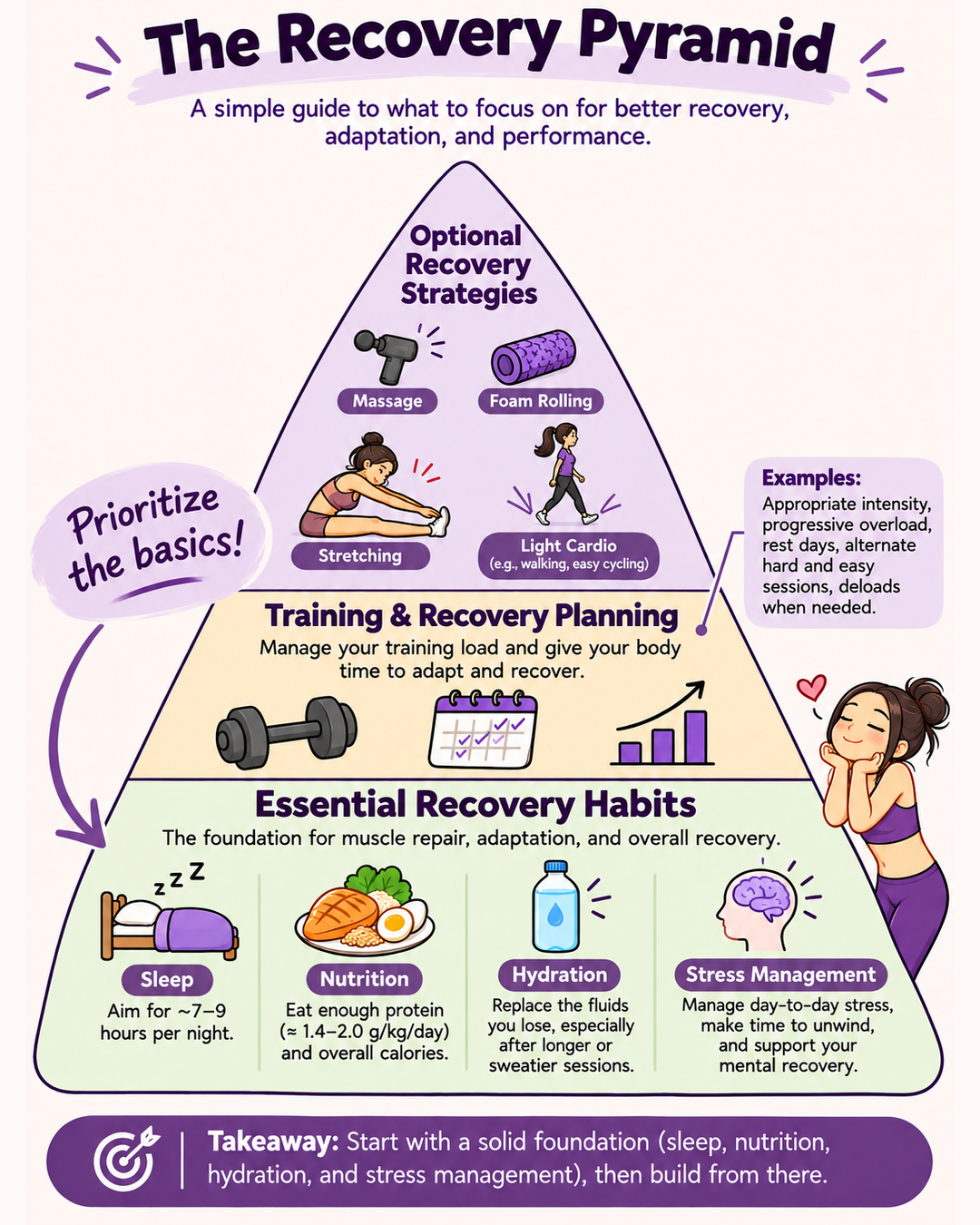
Recovery Pyramid
Recovery Pyramid adapted from Howatson et al. (2026) and Driller & Leabeater (2023)
1. The Foundation: Essential Recovery Habits
At the bottom of the pyramid are 4 things that support your body's recovery:
Sleep
For most healthy adults, aiming for around 7–9 hours of sleep per night is a good starting point.
If you're regularly sleeping only 5–6 hours a night, it may affect how well you recover and perform.
Nutrition
Your body needs sufficient energy and nutrients to adapt to training.
Protein provides the amino acids necessary for muscle repair and growth, while carbohydrates help replenish the energy stored in your muscles.
And don't forget about your overall calorie intake. Even if you're eating enough protein, consistently undereating can still affect recovery.
Hydration
Dehydration can affect your physical performance, especially during longer or more intense workouts.
For many regular workouts, drinking water and eating balanced meals are enough. Longer sessions or heavy sweating may require additional fluids and electrolytes.
Stress Management
This is something people often overlook.
Exercise is a form of physical stress, but it's not the only stress your body experiences.
Work deadlines, family responsibilities, emotional stress, and poor sleep quality can all affect how you feel and how well you cope with training.
Have you ever noticed that a workout that normally feels manageable suddenly feels much harder when you're going through a stressful period?
Sometimes your training hasn't changed, but everything else in your life has.
2. The Middle: Training and Recovery Planning
Even if you're sleeping and eating well, your body still needs sufficient time to recover from exercise.
This means paying attention to your training volume, intensity, frequency, and rest days.
For example, if you're constantly increasing the weights, adding repetitions, or training the same muscles hard without enough recovery, fatigue can accumulate.
Progressive overload is important for building strength, but that doesn't mean you need to push harder every single session.
Alternating harder and easier sessions, allowing sufficient recovery between demanding workouts, and occasionally planning a lighter training week can all be helpful.
3. The Top: Optional Recovery Strategies
This is where things like massage, foam rolling, gentle stretching, and light cardio come in.
These strategies can be useful for managing discomfort, stiffness, or how you feel after exercise.
For example, gentle walking or cycling may help you feel less stiff, while foam rolling or massage may temporarily reduce soreness.
However, feeling less sore doesn't necessarily mean your muscles have physically recovered faster.
Research also suggests that stretching before or after exercise doesn't meaningfully prevent delayed onset muscle soreness.
These strategies are optional, not requirements for recovery.
The takeaway? Prioritize the basics first.
Can You Track Your Recovery?
If you use a smartwatch or fitness tracker, you might have noticed a metric called heart rate variability (HRV). But what exactly does it tell you?
HRV measures the variation in time between consecutive heartbeats and can give us some insight into how our autonomic nervous system is responding to stress and recovery.
For example, if your HRV has been consistently lower than your usual baseline, it could be a sign that your body is under more stress than usual. This could be related to intense training, poor sleep, illness, emotional stress, or a combination of these factors.
However, HRV isn't a direct measure of muscle recovery, and one low reading doesn't necessarily mean you need to skip your workout.
I would pay more attention to trends over time rather than individual daily readings.
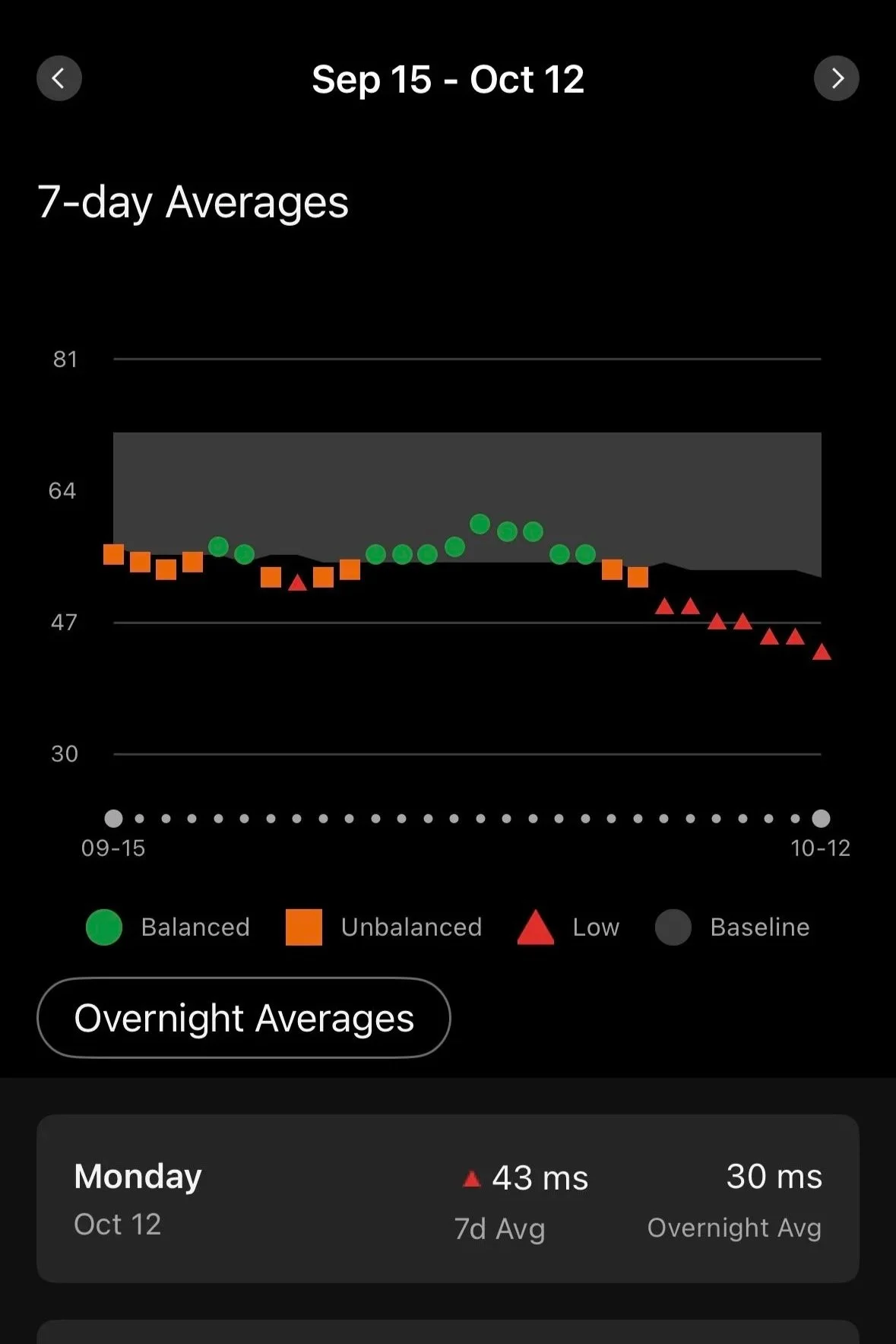
My HRV trend:
Here's an example of my own HRV trend from my Garmin watch. When my HRV stays below my usual baseline for several days, I take it as a sign to prioritize my recovery. I may decrease my training volume and intensity for a few days to see if my HRV bounces back.
And you certainly don't need an expensive fitness tracker to monitor your recovery!
Paying attention to your energy levels, sleep quality, muscle soreness, and exercise performance can also provide valuable information about how well you're recovering.
Why Is Protein Important for Muscle Recovery?
Now that we've covered the bigger picture, let's talk more about nutrition, particularly protein.
Our muscles are constantly going through a process of protein breakdown and rebuilding.
When you perform resistance training, you stimulate muscle protein synthesis, which is the process of building new muscle proteins.
But your body needs amino acids, the building blocks of protein, to support this process.
When you eat protein, your body digests it into amino acids that can be used to repair and build muscle tissue.
If you're not consuming enough protein, you may not be providing your body with the resources it needs to fully support your training adaptations.
Does that mean eating more protein will automatically make your muscles less sore?
Not necessarily.
Research on protein supplementation and muscle soreness has been mixed, and a systematic review found that additional protein did not consistently reduce perceived muscle soreness.
However, getting enough protein is important for building and maintaining muscle mass, strength development, and supporting adaptation to exercise.
How Much Protein Do You Actually Need?
The general recommended dietary allowance (RDA) for healthy adults is 0.8 g of protein per kilogram of body weight per day.
However, this is a baseline recommendation intended to meet basic nutritional needs, not necessarily to optimize muscle growth or training adaptations.
For people who exercise regularly, particularly those doing resistance training, a commonly recommended range is 1.4–2.0 g of protein per kilogram of body weight per day.
Here's what that looks like:
Body weight Daily protein target
50 kg 70–100 g
60 kg 84–120 g
70 kg 98–140 g
80 kg 112–160 g
90 kg 126–180 g
For example, if you weigh 60 kg and exercise regularly, aiming for approximately 96 g of protein per day (1.6 g/kg) could be a good starting point.
Your individual needs will depend on your training goals, activity level, age, and health.
What Does That Amount of Protein Actually Look Like?
You might be surprised by how much food you need to eat to meet your daily protein requirements.
Let's start by comparing common foods.
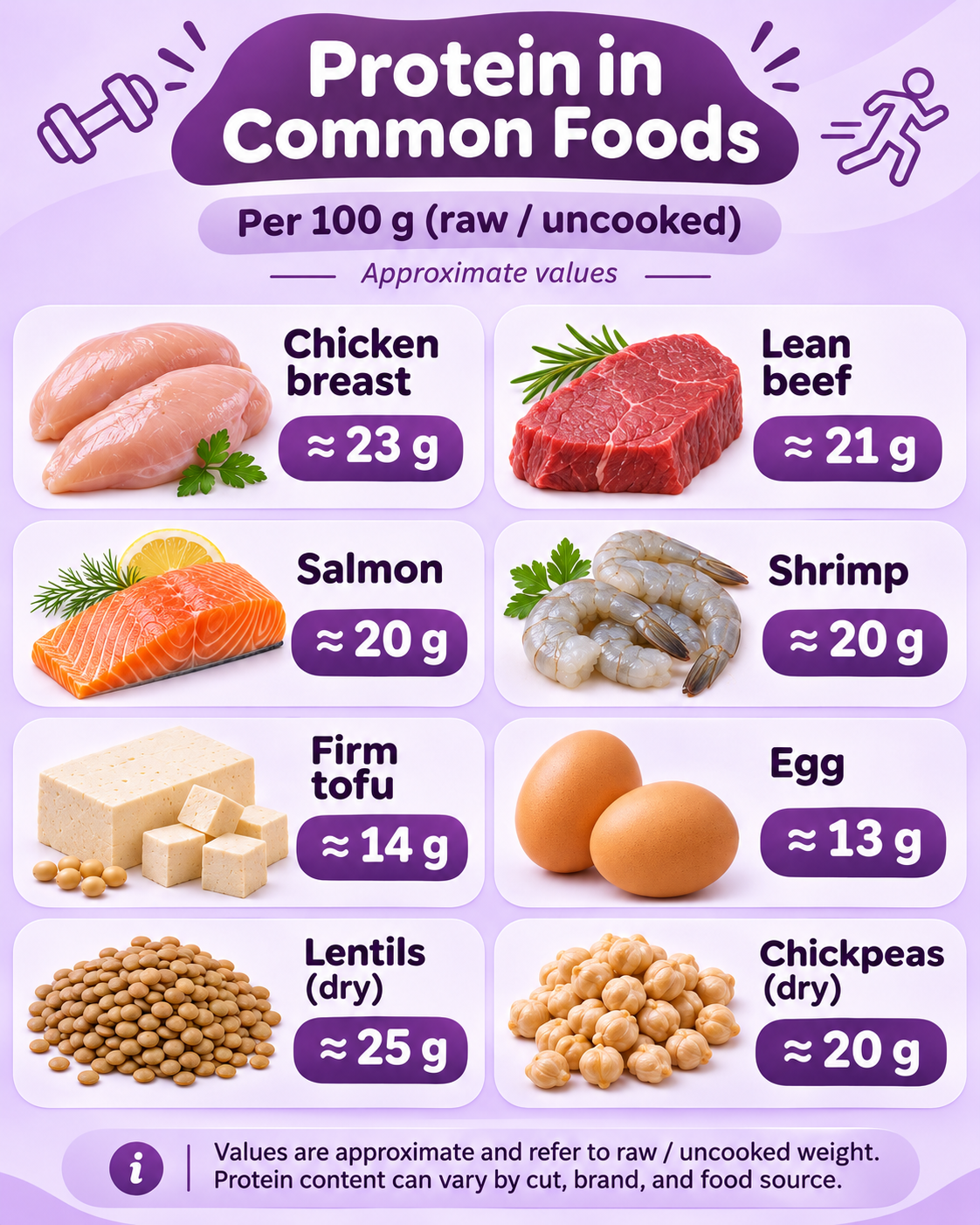
Amount of Protein in Common Foods
Approximate protein content per 100 g of raw or uncooked food.
As you can see, different foods contain different amounts of protein, even when they weigh the same.
For example, 100 g of cooked chicken breast contains approximately 31 g of protein, while 100 g of cooked lentils contains around 9 g.
This doesn't mean one food is necessarily better than the other. They provide different combinations of nutrients, and both can contribute to a balanced diet.
But if you're trying to increase your protein intake, it's helpful to understand how much protein you're actually getting.
Of course, most of us don't weigh every piece of meat before eating it.
So I also put together a visual guide showing what common portions look like on a plate.
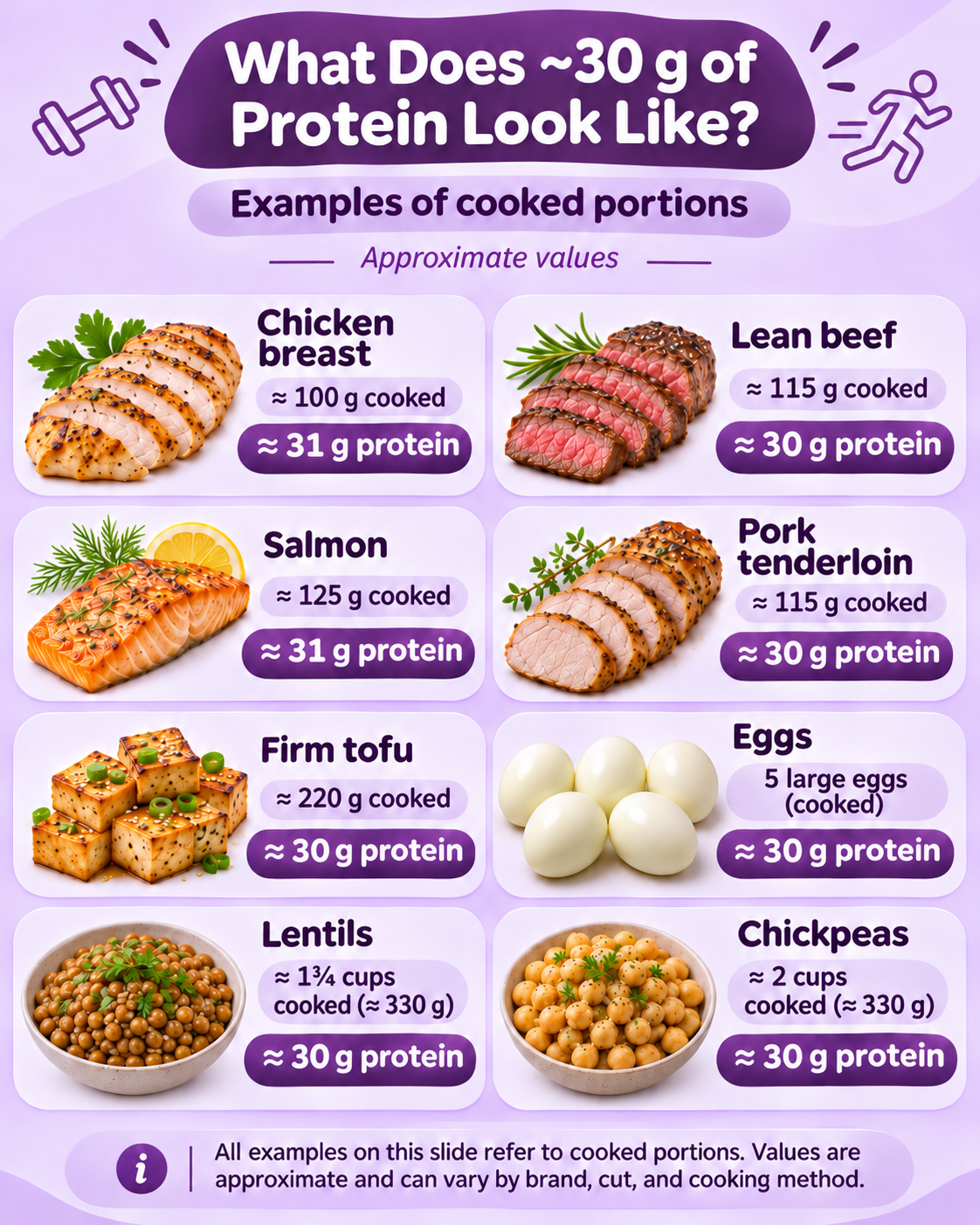
What does a typical portion look like?
Cooked portions.
These values are approximate and will vary depending on the cut, brand, and cooking method. Meat and fish portion weights refer to the cooked, edible portion.
You don't need to eat all your protein in one meal. Spreading your protein intake across breakfast, lunch, dinner, and snacks can make it easier to meet your daily target.
You don't necessarily need protein shakes if you're eating a balanced diet! However, I do find them convenient for busy working professionals, especially when you're eating out frequently and struggling to meet your daily protein target.
So, What Should You Do If You're Always Sore?
If you've been following a similar exercise routine for several weeks or months and you're still consistently experiencing significant muscle soreness, I would encourage you to look at the bigger picture.
Start with the recovery pyramid.
Ask yourself:
Am I getting enough sleep?
Am I eating enough calories and protein?
Am I staying adequately hydrated?
Have I been under more stress than usual?
Am I giving my muscles enough recovery time between demanding workouts?
Also, pay attention to how your body is responding to training.
Are you progressively getting stronger? Does the soreness resolve before your next workout? Are you feeling more capable of performing the exercises?
Or are you constantly feeling exhausted, sore, and struggling to recover?
If you're unsure whether you're getting enough protein, try reviewing your typical food intake for a few days. You might be surprised by how much, or how little, protein you're actually consuming.
Remember that not all muscle pain is DOMS. Persistent, localized, worsening, or unusual pain may need further assessment. Severe pain with marked swelling, weakness, or dark urine after exercise requires urgent medical attention.
Final Thoughts
I often see people focus so much on what they do during their workouts that they forget about everything happening between those workouts.
But training is only one part of the process.
Exercise provides the stimulus for adaptation. Recovery allows your body to respond to that stimulus.
And while protein is an important part of muscle recovery, don't forget about your sleep, overall nutrition, stress levels, and training schedule.
You don't need to feel sore after every workout to know you're making progress.
Sometimes, improving your results isn't about adding another workout.
It's about making sure you're giving your body what it needs to recover and get stronger.
If you're consistently struggling with muscle soreness, finding it difficult to recover between workouts, or unsure how to return to training after an injury, a physiotherapist can help you figure out what's holding you back and develop a plan that works for you.
If you're in Toronto, feel free to book an assessment with me.
I'll also be writing about how to structure your training when preparing for a pole competition in my next blog post, so stay tuned!
References
Driller, M., & Leabeater, A. (2023). Fundamentals or icing on top of the cake? A narrative review of recovery strategies and devices for athletes. Sports, 11(11), 213.
https://doi.org/10.3390/sports11110213Howatson, G., Russell, S., Pedlar, C., & Halson, S. (2026). Physical and mental recovery for female footballers: Considerations and approaches for better practice. Sports Medicine, 56(Suppl 1), 75–89.
https://doi.org/10.1007/s40279-025-02246-xJäger, R., Kerksick, C. M., Campbell, B. I., et al. (2017). International Society of Sports Nutrition Position Stand: Protein and exercise. Journal of the International Society of Sports Nutrition, 14, 20.
https://doi.org/10.1186/s12970-017-0177-8Pearson, A. G., Hind, K., & Macnaughton, L. S. (2023). The impact of dietary protein supplementation on recovery from resistance exercise-induced muscle damage: A systematic review with meta-analysis. European Journal of Clinical Nutrition, 77, 767–783.
https://doi.org/10.1038/s41430-022-01250-yWalsh, N. P., Halson, S. L., Sargent, C., et al. (2021). Sleep and the athlete: Narrative review and 2021 expert consensus recommendations. British Journal of Sports Medicine, 55, 356–368.
https://doi.org/10.1136/bjsports-2020-102025Herbert, R. D., de Noronha, M., & Kamper, S. J. (2011). Stretching to prevent or reduce muscle soreness after exercise. Cochrane Database of Systematic Reviews, (7), CD004577.
https://doi.org/10.1002/14651858.CD004577.pub3Esco, M. R., Fields, A. D., Mohammadnabi, M. A., & Kliszczewicz, B. M. (2026). Monitoring training adaptation and recovery status in athletes using heart rate variability via mobile devices: A narrative review. Sensors, 26(1), 3. https://doi.org/10.3390/s26010003
